
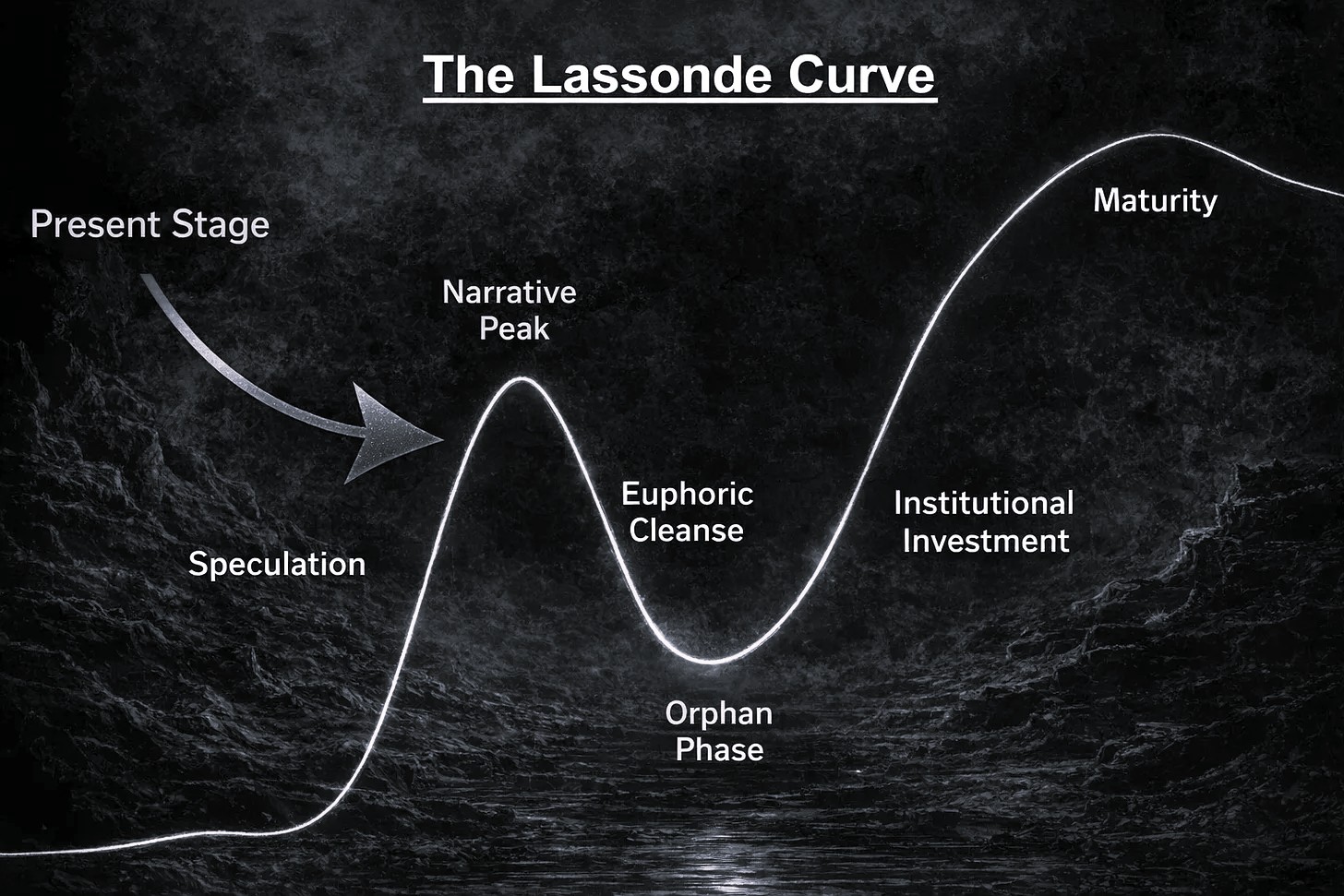
If you are an investor in the natural resource sector the Lassonde Curve model is foundational. It offers a structural understanding of the non-linear progression of producer valuations from exploration to production across the entire resource sector. The principles can be equally applied to subsegments of natural resources and the sector as whole.
.
.
HISTORY
.
.
The curve was developed by Pierre Lassonde, a legendary Canadian mining investor and co-founder of Franco-Neveda. Lassonde created the model to help investors navigate the extreme volatility and risks inherent in natural resource investments.
The model highlights 7 key stages:
1. Concept/Exploration
2. Pre-Discovery
3. Discovery
4. Feasibility
5. Development
6. Production
7. Depletion
Key takeaway: Valuations in natural resources follow a non-linear path.
Interpretations of this model can be applied more broadly to cycles within the natural resource sector:
Highlighting initial early stages of Speculation to Institutional Capital flows.
.
.
WHAT STAGE IS THE PRESENT CYCLE IN NOW?
.
.
THE BEGINNING
The natural resource sector, critical minerals and materials specifically, are entering a paradigm shift. Technological transformations and geopolitical tensions have exposed massive deficits (global and regional) in critical supply, underpinned by decades of underinvestment. In the context of the Curve, the sector has a whole is entering a reset, with many regional subsegments of the natural resource sector essentially starting at 0 .
.
.
The first peak
.
.
The market has largely begun to acknowledge the super-cycle in critical minerals & materials.
Event driven Narrative (China export restrictions) has driven sentiment and subsequently, valuations to euphoric levels – beginning to price future supply-demand inflections. In addition to existing capacity expansion in well known metals (copper, silver) and materials producers, innumerable new developments are underway in emerging demand segments (scandium, graphite). Capital is accelerating the velocity of the new critical materials supercycle. In many cases, it has largely been dispersed in the form of a shot-gun blast – indiscriminate of project viability or balance sheet resilience. At this stage of the cycle, the distinction between narrative and underlying fundamentals becomes critical.
.
.
narrative vs fundamentals
.
.
Recent enthusiasm for critical materials has led to a rapid influx of capital into early-stage development companies. Many firms currently commanding large market capitalizations remain years away from commercial production, with projects still in feasibility or permitting stages.
While the long-term demand outlook for materials such as lithium, graphite, and rare earth elements is compelling, the timing mismatch between capital markets and project development timelines can create periods of valuation dislocation.
In resource markets, supply responses typically unfold over decades rather than years. When capital flows accelerate too quickly, the result is often a speculative expansion followed by a period of consolidation as projects move through the slow realities of development.
.
.
cycle compression
.
.
Mining projects require a decade to build. Capital markets price demand in a matter of months.
A defining feature of the current critical materials cycle is the compression of narrative and capital formation relative to the underlying timelines required to develop new supply.
The result is a structural mismatch between financial expectations and industrial reality. In effect, capital markets frequently attempt to pull future supply shortages forward in time, pricing scarcity years before it manifests and projects can deliver material production. This dynamic can produce dramatic valuation expansions in early stages of the cycle, followed by periods of consolidation as the slow realities of feasibility studies, permitting, financing, and construction reassert themselves.
.
.
the reconciliation
.
.
Narrative is pricing future supply-demand deficits today. While the coming supply-demand inflections are real, and are increasingly eminent, narrative is accelerating valuations ahead of current fundamentals. Most critical mineral developers currently attracting capital remain pre-feasibility, pre-development and will not reach commercial production for 5-10 years. The market, and more importantly, valuations will reconcile with current structural fundamentals: macro fundamentals, current supply-demand dynamics, and company specific project economics.
The market’s relationship with time is dynamic: pulling the future forward at times and at others, remain inert – quietly coiling before it catches up to structural reality. From a capital allocation perspective, it is crucial to incorporate the markets dynamic relationship with time, narrative, and reality to anticipate the fluctuations that define the non-linear trajectory of valuations.
.
.
the valley of death
.
.
“Orphan Phase”
Will be defined by a host of factors:
Execution: Delays in project timelines – permitting, construction overruns
Dilution: Capital raises to fund projected and unanticipated capital requirements
Estimate Downgrades: Transition from inferred to proven reserves
Risk: Operational risk events that disproportionately impact new developments
Overhang: Warrant/Options exercises overwhelming liquidity
HISTORICAL PARALLEL
Uranium Cycle (2005–2007)
Exploration companies multiplied in value before production.
Then:
• capital dilution
• project delays
• collapse in prices
.
.
the durable ascension
.
.
Institutional Capital Flow
Institutional capital prefers to allocate once a sector, and specific companies within have evolved from speculative upside narrative to de-risked, technical, and commercial viability. Essentially, a shift from narrative to operational and financial durability. This is a transition that the sector, subsegments, and companies within will need to demonstrate by proving demand (scandium), capital discipline (MP Materials), and execution capability (Standard Lithium).
.
.
the opportunity
.
.
Although key factors impacting the severity of the trough will be predominantly company specific, the broader impact will be largely indiscriminate. The rinsing and cleansing of speculative euphoria will punish even the best producers in the natural resource sector and specific subsegments. This phase will offer an opportunity to build positions in the companies displaying the strongest qualities, indicative of top-tier companies, the ones positioned for durable success in the super-cycle that is unfolding.
.
Comment (1)