
Markets are a flow chart of capital. Capital never disappears. It reappears, flowing, reallocating, at times seemingly teleporting from one asset class or sector to another. From a capital allocation perspective, the objective is to anticipate these flows.
The central questions: Where is capital concentrated? Where will it flow next?
The answer to the former is obvious. Capital today is concentrated in the technology sector, with an overwhelming focus on the AI transition. The companies leading this transformation will almost certainly continue to advance, developing technology, growing revenues, and attracting incremental capital. From a capital allocation perspective, however, the first-mover advantage, and the excess returns that accompanied it, have largely passed.
Where is the macro compass pointing?
Capital concentration is clear; its next destination is not. Market consensus insists that AI exposure is a necessity, not a luxury. While this is indisputable, the mainstream approach to gaining that exposure is increasingly narrow.
For decades, even prior to AI, capital gravitated toward software, platforms, and digital infrastructure. Only recently has the market begun to acknowledge what lies beneath that layer. NVIDIA is emblematic of this transition: capital has moved decisively from software narratives toward the hardware that enables technological systems to function at scale.
The Direction
Capital is now flowing down the technology stack: from software and platforms to hardware and infrastructure. That is the direction. The question is where that path ultimately leads.
What lies beneath the hardware? What inputs are required to manufacture it? Where do those inputs originate? And most critically for capital allocation: who is positioned to supply the physical materials required for the AI and Electrification transformation to fully materialize?
The Iceberg
Markets are a flow chart of capital. Concentration in one segment necessarily creates deficits elsewhere. Commodities broadly, and critical materials specifically, have borne the consequences of this imbalance. Underinvestment across mining and refining has been profound . Capital has systematically migrated away from the industries responsible for physical supply as the global economy’s material intensity has quietly increased.

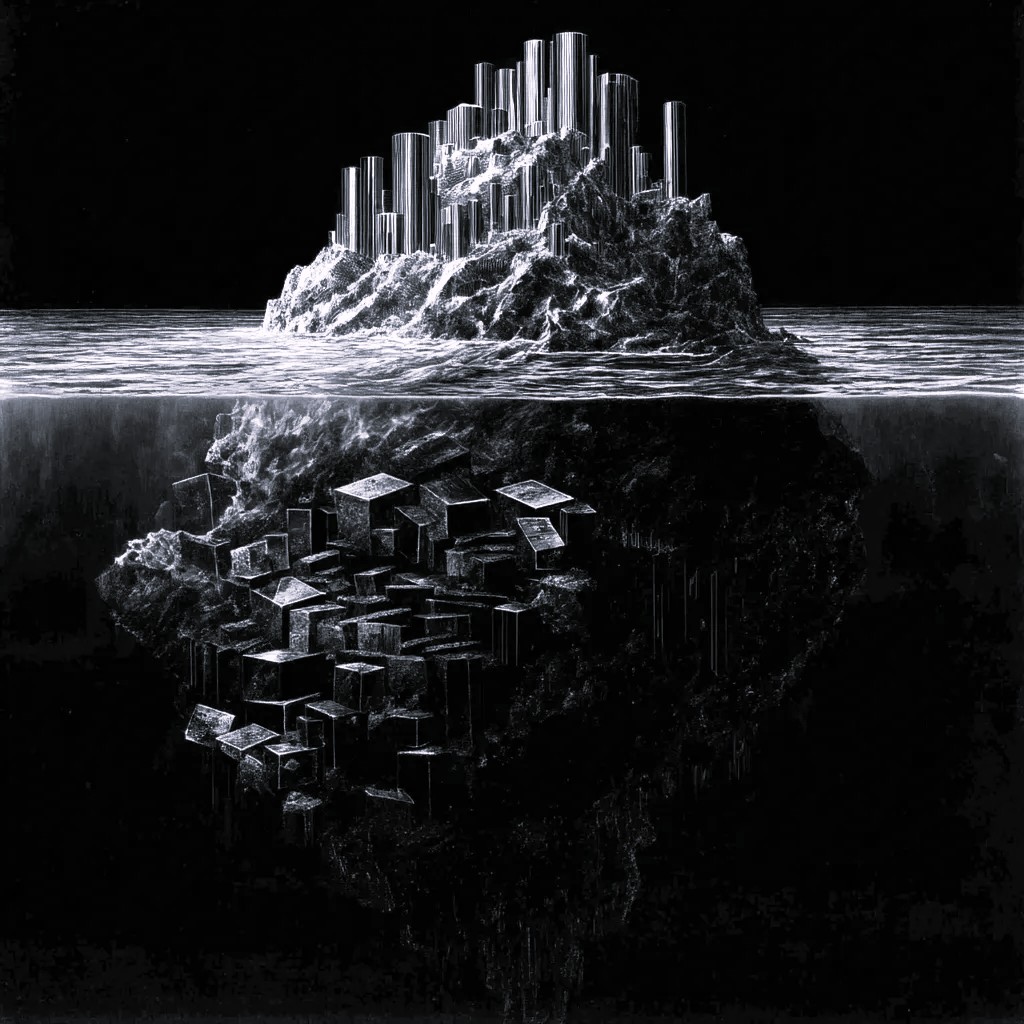
This is the iceberg. The market prices the visible layer: software, intelligence, electrification — while discounting the upstream inputs that govern feasibility, cost, and timing. When allocation compresses to historic lows, supply does not disappear gracefully.
The constraints visible today represent the tip of a much larger structural inadequacy within global supply chains.
Recent geopolitical developments have begun to expose the magnitude of this neglect, particularly in mining and refining capacity for critical materials. Yet markets have only started to scratch the surface.
This underinvestment is not a failure of intelligence. It is a consequence of capital allocation time horizons that are incompatible with physical systems. Incentives reward consensus participation and narratives that compound smoothly. Physical supply chains do not. The sector carries deep scar tissue: political risk, cost overruns, permitting failures, operational blowouts, and dilution. Events such as recent disruptions at Grasberg, the world’s second-largest copper mine, underscore these realities.
While these rationalizations persist, the nature of demand has fundamentally changed. What was once cyclical and discretionary has become non-discretionary. Technological transitions, energy security imperatives, and industrial policy have transformed demand into something policy-backed and in many cases unavoidable.
This new reality collides directly with physical constraints. Supply elasticity has collapsed. Permitting timelines are lengthening, environmental standards are tightening, and geopolitical tensions are front and center. Markets can ignore constraints for long periods, rendering them mispriced until they enforce themselves.
The scale and velocity of the AI-driven transformation of the global economy is Titanic. Until recently, it has sailed unencumbered at the speed of technological iteration, but an obstacle lies in its path. Some market participants can see the tip of the iceberg – the first-order effects of physical constraints: energy for data centers, copper for electrification, rare earths for advanced systems. The bummock of the iceberg however remains hidden below the surface. Its depth, composition, and implications are poorly understood and vastly unpriced.
Oculus
Where markets see narratives, Oculus studies structure. Where capital fixates on what is visible, Oculus focuses on what lies beneath.
Oculus exists to systematically explore the submerged portion of this iceberg: the material constraints, supply–demand imbalances, and execution risks that will shape real outcomes. The methodology begins at the macro level, traces capital flows through technology and infrastructure, and ultimately grounds analysis in physical reality: geology, industrial capacity, timelines, and cost structures.
Opportunity does not present itself at the surface level. It forms where inevitability meets neglect: where markets are late to recognize constraints and slower still to price their consequences. Oculus’ mandate is to identify those inflection points before they become consensus, and to understand which assets are positioned to benefit when physical reality asserts itself.
The iceberg is real. Oculus’ mandate is to map it before markets are forced to.