
Titanium is not constrained by ore. It is constrained by a process designed in the 1950s.
A company is attempting to replace that process.
The market is not pricing in what happens if the company is successful.
.
.
Macro Thesis
.
.
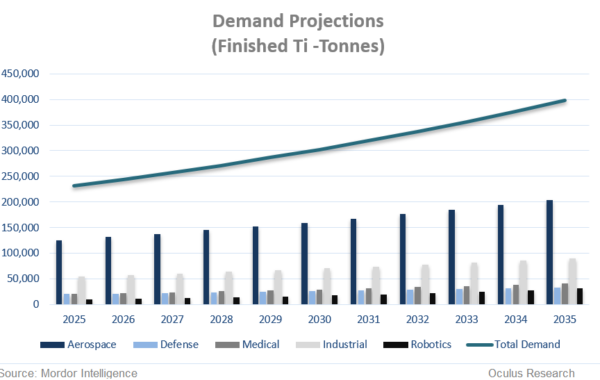
Titanium is one of the most overlooked components in increasingly critical high-performance applications. Today, the majority of Titanium demand is consumed by aerospace and defense sectors but segments like medical implants and robotics are experiencing rapid growth.
.
.
This growing demand and increasing importance of Titanium is taking place against a backdrop of considerably constrained supply. Titanium supply is defined by technological complexity and geographic concentration. While the market currently remains well supplied, supply inelasticity in the outer years poses a significant risk, particularly to Western countries with fundamentally zero existing production capacity.
.
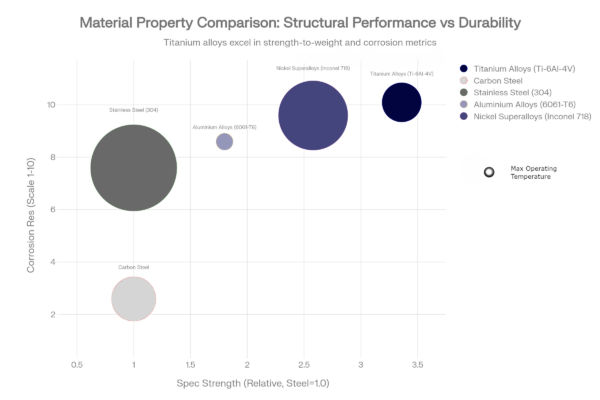
Titanium currently sits at the intersection of aerospace, defense, and advanced manufacturing. It is a material not defined by abundance but by its unrivaled performance.
.
.
Titanium’s strength-weight ratio, corrosion resistance, and heat tolerance make it irreplaceable in critical applications, particularly within defense and aerospace systems where failure is not an option.
Demand is not purely cyclical. It is structural.
.
.
Robotics Demand Convexity
.
.
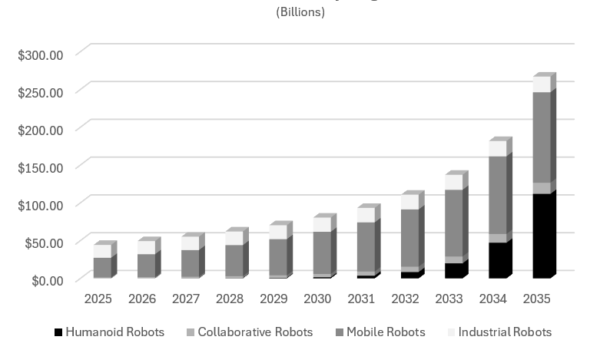
The introduction of robotics, particularly humanoids, will create a demand cycle that is material different from prior cycles – one that pushes mechanical systems into continuous human-like cycles with strict energy, fatigue resistance, and durability first designs. These stringent requirements will drive Titanium demand and significantly limit substitution. This emerging demand segment has the potential to meaningfully reshape the future demand landscape.
.
.
“There will be more robots than humans” – Elon musk
.
.
The Geographical Bottleneck
.
.
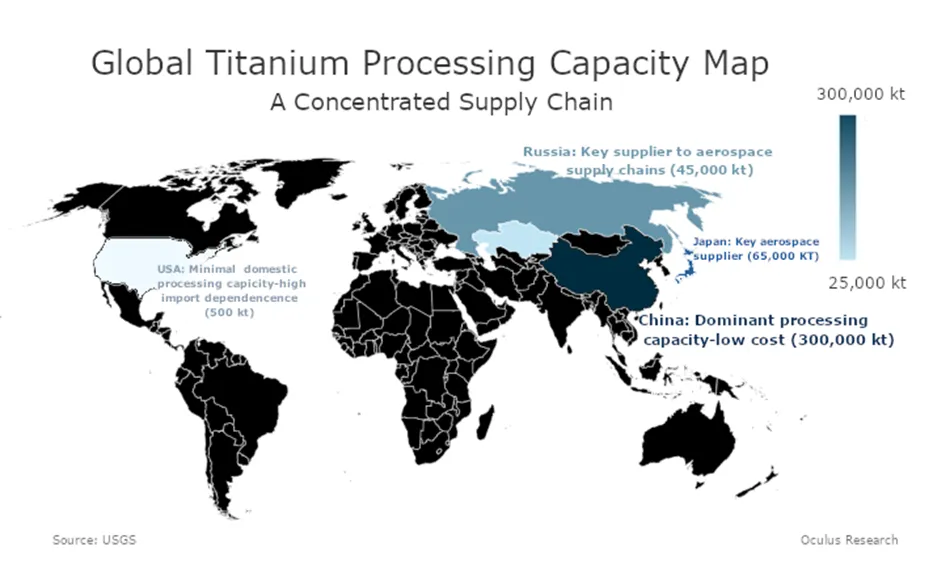
Today, global Titanium processing capacity is heavily concentrated in Russia and China, jurisdictions that exist outside of Western Industrial and Defense alliances. Unites States, by contrast, has negligible domestic processing capacity, particularly in relation to its demand profile.
.
.
The geographic concentration of the supply chain creates a structural imbalance.
This dynamic is particularly alarming for Western countries. For the U.S. in particular, Titanium is not simply a commodity input. It is a strategic dependency embedded within critical supply chains. Titanium was officially designated a critical material (2025) by USGS and is considered “critical to national security” by the Department of Defense (DOD).
In a market where vulnerability intersects with strategic necessity, policy and capital follow.
This distinguishes Titanium as not simply a story of rising demand, but a story of constraint, concentration – one increasingly defined by strategic supply.
.
.
The Technological Bottleneck
.
.
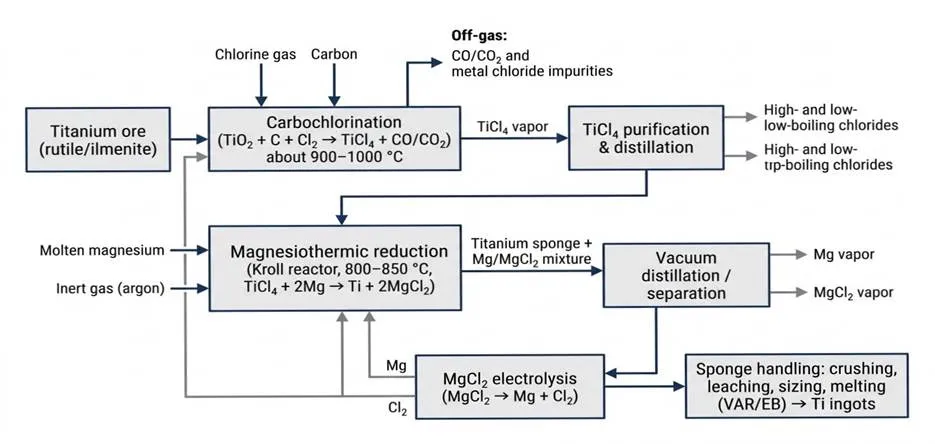
While Titanium’s supply-chain’s geographical constraints are formidable, its predominant bottleneck lies in its technologically complex and energy intensive processing requirements.
At the center: The Kroll Process
.
.
Despite incremental improvements, the process has changed very little since the 1950s
Each stage is complex, energy-intensive, and time consuming. Most importantly, the process is inherently batch-based, not continuous. The method results in non-uniform batches and considerable down periods between batches for cleaning and preparation.
A single production can take more than 10 days from deduction to cooling to recovery.
Every step of the process is highly energy-intensive, from feedstock prep. to purification.
The core limitation: Multiple discreet cycles: Load – react – distill – cool – extract – repeat
New production capacity requires specialized high-temp reactors, complex handling of reactive intermediates, and long commissioning timelines.
Titanium is not constrained by ore, but by a process designed for a different era.
.
.
The Game Changer
.
.
IperionX is on the brink of disrupting the status quo of the century-old industry.
The company’s proposition is not to discover new Titanium supply.
It is to redefine how Titanium is produced.
.
Process-Level Innovation
IperionX (IPX) is advancing a hydrogen-based metallization process designed to convert titanium feedstock (including both scrap and ore) into high-purity Titanium metal through a fundamentally different technique than the legacy Kroll process.
IPX’s proprietary technology eliminates the Kroll Process’s most problematic steps:
Chlorination: No need to convert titanium ore into toxic titanium tetrachloride
Vacuum Distillation: The energy-intensive, multi-day purification step used in the Kroll process is removed.
HAMR (Hydrogen Assisted Metallothermic Reduction)
IPX’s proprietary technology enables the production of low-oxygen Titanium hydride powder without the need for high-temperature chlorination or vacuum distillation by bypassing the most expensive phase (sponge).
HSPT (Hydrogen Sintering and Phase Transformation)
The process essentially presses the Titanium powder into a specific shape (green body) and heated below its melting point. The presence of hydrogen (from HAMR) acts as a temporary alloying element that helps the particles fuse together. The final step is the vacuum removal in which the hydrogen is pumped out, leaving behind a solid, high-performance titanium part.
The Result:
High-Purity Titanium with less waste, in less time at a notably lower cost.
.
.
Proprietary Market Edge
.
.
1. Scalability
IPX’s approach is designed to move to a continuous or semi-continuous flow system.
This is a key breakthrough from discreet production cycles to scalable throughput
.
2. Cost & ESG Leader
By using their proprietary method, IPX is targeting:
- 50% energy consumption compared to traditional method
- Near-zero Scope 1 & 2 emissions
- A long-term cost profile potentially approaching $29/kg
These are not marginal gains.
.
3. Feedstock Flexibility
IPX’s process introduces the potential to utilize:
- Lower-grade feedstock
- Scrap material
- Alternative inputs
This considerably expands the addressable supply base.
IPX is not competing within the existing system.
It is creating an entirely new system.
.
.
Strategic Position
.
.
Location
IPX is positioned to become the largest vertically integrated producer of Titanium in the U.S. and the West. This carries significant advantages in a jurisdiction increasingly focused on securing domestic supply chains. In a market dominated by non-Western supply, location becomes leverage.
.
US Government Funding:
- $47 million IBAS Award to scale manufacturing facility.
- $99 million contract (phase 3) to supply U.S Army with Titanium components
- $11 million EXIM direct loan approval (2025)
US Policy Support:
- U.S. gov transferred 290 mt of Titanium alloy scrap (2026) to IPX for feedstock.
- Likely beneficiary of $10 Billion EXIM “Project Vault” initiative
- Beneficiary of tariffs and reshoring policy (existing and future)
.
Vertical Integration
- IPX plans to control the entire supply chain from raw materials the final manufacturing
- Owns the Titan Project – one of the largest deposits of Titanium and REE (Bonus) in US.
- Operates an advanced manufacturing center for High-Performance Part Production.
- 3D Printing integration – to create complex parts with minimal waste
- Scrap re-utilization – traditional “waste” is reprocessed and utilized in new cycles
.
.
The Reality
.
.
Uncertainty
Despite the promise of its process, and significant milestones having been met, IPX has not yet proven viability at full-scale production.
Advancing from:
- Laboratory validation
- To pilot production
- To sustained industrial output
Is where many process innovations fail.
Operational Challenges
What works in controlled environments does not always translate to industrial scale.
Key Challenges:
- Consistency of output
- Impurity control
- Throughput stability
- Integration into real world supply chains
.
Execution Risk
Execution remains a considerable challenge even if the technology is proven at scale
Scaling a new metallurgical process requires:
- Capital discipline
- Engineering precision
- Time
.
.
The Short Case (Spruce Point)
.
.
Emerging technology is typically met with skepticism.
In the case of IPX, that skepticism has been formalized by Spruce Point Capital. Their short thesis questions the company’s technology, commercialization pathway, and the company’s valuation ($50 a share at the time of publishing). These critiques merit examination, not dismal.
The Core
- Technology risk – whether the process can be successfully scaled
- Commercialization uncertainty – regarding timelines, capital requirements, and sustained full-scale production.
- Economic viability – skepticism of projected costs & actual efficiency advantages
Distilled – The technology may be promising but unproven in practice.
IPX’s Position
From its perspective, progress has been made and milestones have been achieved:
- Advancement through pilot and demonstration phases
- Continued development of proprietary patented technology
- Alignment with strategic and government linked initiatives
Distilled – The scaling of their process is matter of execution, not feasibility
.
The Reality
Both perspectives hold truth. The short case highlights real risks. That is the nature however, of early-stage disruption – in many cases it is fragile, seemingly improbable, until a critical threshold is crossed.
.
.
The Asymmetry
.
.
IPX is not a linear investment.
It’s a distribution.
.
The Left Tail
If the technology fails at scale or execution falters the downside is well defined.
- Commercial viability is not achieved
- Capital is consumed without return
- The equity reflects that outcome accordingly
There is no ambiguity to the downside.
.
The Right Tail
If the technology proves viable at scale, the implications extend beyond the company.
- A structurally constrained production process is disrupted
- The cost curve for titanium compresses
- Strategic relevance increases within Western supply chains
In this scenario the outcome is not incremental,
it is multiplicative.
.
The Asymmetry
What distinguishes IPX is not the range of outcomes, but the imbalance between them.
The downside – finite
The upside – industry-wide impact and significant capital reallocation
This is bet is not exclusive to titanium demand,
it is a bet on whether the constraint defining supply can be removed.
.
.
Where the Market is Wrong
.
.
The market is not only mispricing titanium demand.
It is mispricing how supply changes.
Current pricing reflects:
- a niche materials company
- an unproven process
- a long path to commercialization
It does not reflect:
- a potential reset of the production cost curve
- a shift from batch to scalable production
- the strategic value of domestic titanium capacity
The result:
A technology with system-level implications is being priced as a single-asset execution story
That disconnect defines the opportunity.
.
.
The Convex Bet
.
.
There are very few ways to express a titanium thesis in public markets, particularly in the West.
Fewer still offer true convexity.
.
IPX sits at the Intersection of:
- A structurally constrained market
- A concentrated and geopolitically sensitive supply chain
- A potential process level industry disruption
That combination does not produce linear outcomes, it produces asymmetry
.
The market is currently pricing:
- An unproven technology
- A company pre-scale
- A wide range of possible outcomes
The uncertainty reflected in the price is what defines the opportunity.
.
.
Exposure Framework
.
.
This is not a set up that rewards precision timing.
It requires a framework built around staging, flexibility and
a significant tolerance for volatility
The opportunity calls for positioning through the development curve.
Exposure structured around:
- staging – building into development milestones
- volatility tolerance – accepting drawdowns as part of the process
- time horizon alignment – underwriting multi-year execution
Positioning is not based on near-term catalysts.
It is based on the progression from validation – scale – adoption
As that progression de-risks, the market’s pricing mechanism changes.
The opportunity exists in the transition.