

The expired thesis
.
Global nickel production continues to outpace demand. Indonesian supply is flooding the market, and inventory levels at SMM/LME remain elevated, creating an overhang. But this does not tell the full story…
One Metal: Two Markets
There are two distinct classes of nickel:
- Class 1 (high-purity) — generally derived from sulfide deposits
- Class 2 (low-purity) — generally derived from laterite deposits
The distinction lies in their use cases. Class 2 is primarily used in steel production, while Class 1 demand is driven by lithium-ion battery production.
The oversupply narrative stems from the deluge of Indonesian Class 2 nickel. The demand for the key growth driver (LIBs) is for Class 1.
.
.
the break
.
.
The bifurcation in the market has collapsed, shifting from a Class 1 constrained / Class 2 abundant market to a more uniform supply.
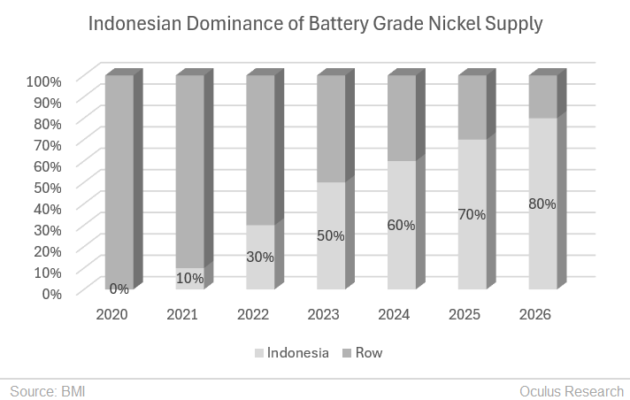
In 2020 Indonesia placed a ban on raw export restrictions, forcing foreign investment in processing capabilities. This led to a boom in refining capacity fueled by the development of HPAL facilities.
High-Pressure Acid Leach (HPAL) plants producing Mixed Hydroxide Precipitate (MHP) have largely eliminated geological constraints on high-purity nickel. They enable low-cost processors to convert abundant Class 2 material into high-purity feedstock suitable for battery and high-nickel chemistries.
.
.
High-purity nickel has transitioned from geological scarcity to being defined by geographically concentrated industrial manufacturing. Indonesia, supported by extensive Chinese investment, has become the vertically integrated cost leader for both low- and high-grade nickel.
.
.
the illusion
.
.
Until recently, nickel was defined by constraint. High-grade sulfide deposits were limited and increasingly difficult to develop. Accelerating battery demand created an inevitable projection of supply deficits, embedding scarcity into the market narrative.
Many participants continue to see nickel through this lens, where geology is the primary bottleneck. But the constraint has shifted; what was once geological is now industrial.
Price volatility has reinforced the illusion. Nickel has experienced significant spikes, often interpreted as confirmation of tight supply. In reality, these movements reflect short-term dislocations: short squeezes, policy shocks, and liquidity constraints. Such signals can resemble scarcity but are disconnected from underlying structural supply.
Today, the new supply reality is still being interpreted through a scarcity framework. It will take time for the market to internalize the structural change.
.
.
the new system
.
.
Supply is no longer determined by the development of high-grade deposits; it is now defined by the capacity to convert low-grade ores into high-purity material (MHP).
This shift has accelerated rapidly with Chinese investment in integrated mining, processing, and refining facilities in Indonesia. Expertise and capital have compressed timelines and lowered barriers between resource and end-market. Supply is now fluid: manufactured, expanded, and redirected. Remaining constraints are functions of capital deployment and policy.
.
.
the consequence
.
.
Market prices for all forms of nickel are structurally suppressed. Supply can now expand through processing and is no longer limited by discovery or geological development, muting scarcity-driven upside potential. Elastic supply makes it difficult for the market to sustain elevated prices.
The second-order effects are significant for nickel projects and companies, especially high-cost operations. Marginal projects are at risk of becoming uneconomic. Assets once structurally advantaged may no longer generate returns if pricing fails to support cost bases.
Geography and geopolitics now define the market. Indonesia dominates supply, with Chinese-controlled (~75%) processing facilities concentrated in the region. New Chinese export regulations impact processors using Chinese technology in Indonesia. Manufactured supply concentrated in specific regions introduces new dependencies and risks. It ultimately gives China and Indonesia significant leverage against western countries.
.
.
the setup
.
.
The opportunity has not disappeared, but it has shifted.
Broad exposure to the commodity is now a weak expression of the theme.
Outcomes are no longer driven by nickel direction alone, but by where within the market the exposure sits.
Not all supply is equal. Geography, jurisdiction, and integration into downstream value chains matter more than headline grade or resource size.
The market, however, continues to price much of the sector using the old framework.
In our forthcoming report, we will take this a step further, distilling the structural shift into a clear, actionable exposure opportunity.
.