
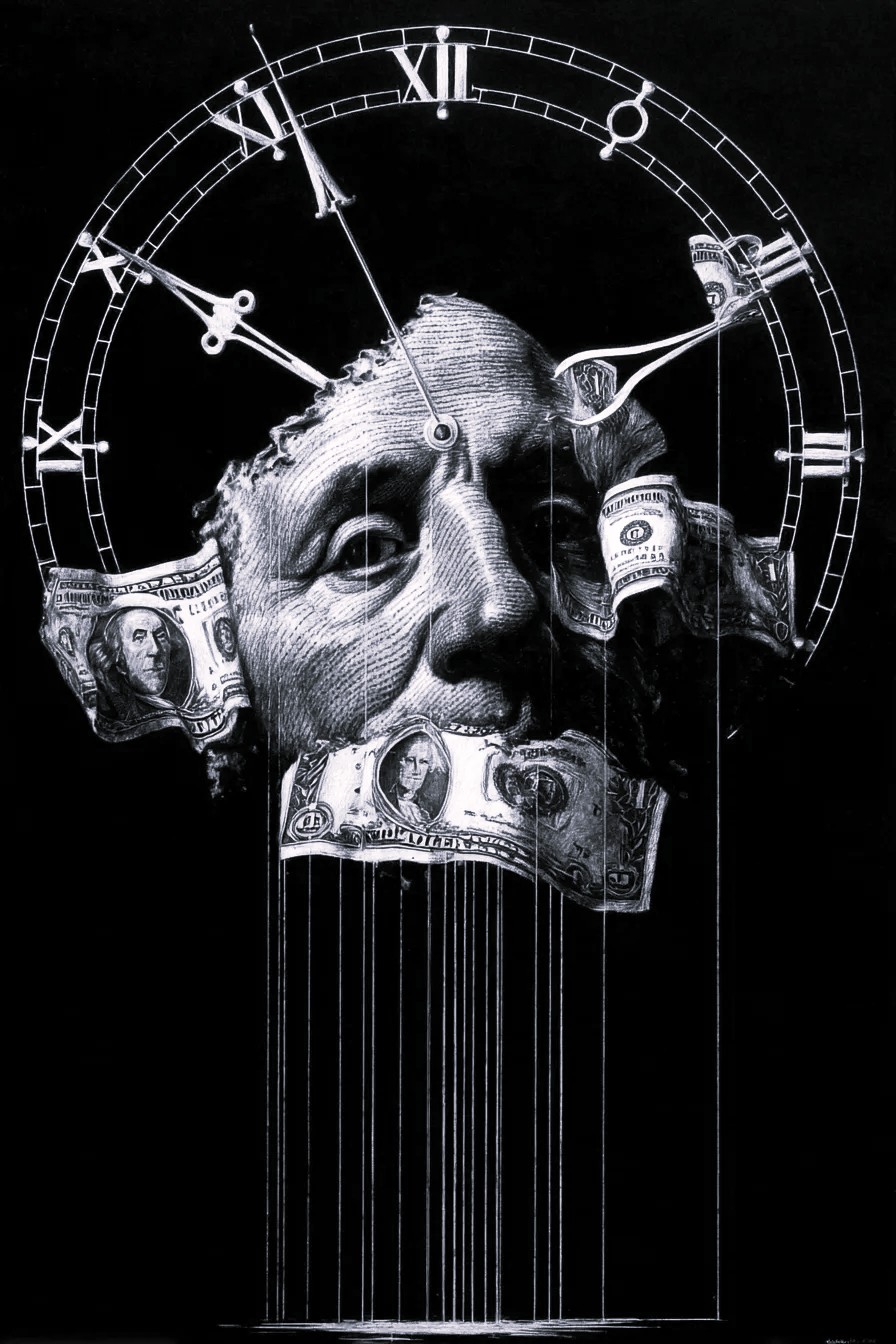
Markets are complex systems with countless moving parts. Variables overlap, interact, and compound. Among them, one is consistently misunderstood, miscalculated and underweighted: time.
Conviction in markets is difficult to sustain not because ideas are scarce, but because timing is elusive. A thesis can be fundamentally correct yet produce no value if the variable of time is miscalculated. Accuracy alone is insufficient. Markets do not reward correctness in isolation; they reward correctness within a narrow temporal window.
To understand this, it is necessary to first recognize what a market is and what it is not. A market is not a reflection of fact. It is an abstraction: an aggregation of sentiment, expectations, and narrative. Prices are shaped less by reality itself than by collective perception of what reality might become. This distinction is paramount in understanding how time functions in markets.
The prevailing mantra is that markets are forward-looking. At times, this is undeniably true. The COVID pandemic offers a clear illustration. At the height of global paralysis, when uncertainty was at its peak, markets bottomed. The pandemic was far from over, yet the market began to rise aggressively. Markets moved not on present conditions, but on expectations of eventual resolution. Time was compressed; the future was pulled forward.
The relationship between markets and time, however, is not linear. The blade cuts both ways.
In the aftermath of the pandemic, governments injected unprecedented liquidity into the global economy. Roughly 40% of existing M2 was created to counter the economic consequences of the pandemic. The second-order effects: substantial currency debasement and inflation. Markets rallied broadly. Risk assets surged. Inflation-sensitive assets and barometers of M2, precious metals, rose initially alongside the broader market.
Then they stalled.
For years, precious metals languished. Despite persistent inflation, fiscal deterioration, and expanding sovereign balance sheets, markets largely ignored the monetary implications. Capital flowed elsewhere. Narratives shifted, yet reality remained unchanged.
Years later, only recently, markets collectively chose to acknowledge what had long been observable. Currency debasement entered public discourse. Precious metals repriced violently. The move appeared sudden, even shocking to those who had not been positioned.
Yet nothing fundamental had changed.
The variable was not information, nor was it policy. It was time. In this instance, the market was not forward-looking. It was inert, quietly coiling, until it wasn’t.
These episodes illustrate the market’s dynamic asymmetric relationship with time. At moments, markets leap forward, discounting outcomes well before they materialize. At others, they remain dormant, ignoring realities that are plainly visible. The same market that anticipates recovery years in advance can ignore structural imbalances and material realities for years and decades.
The latter of this dynamic creates a dangerous illusion. It becomes easy, in hindsight, to celebrate inevitable outcomes while dismissing the hidden cost; even a broken clock is right twice a day. In markets, miscalculating time is indistinguishable from being wrong; even when the thesis was correct.
Silver offers a stark example. Investors in precious metals are jubilant today, but it is important to take a step back to look at the big picture. At roughly $100, the price of silver has increased by 100% since its 1980 peak. Over the same period, the S&P 500 has delivered a nominal return exceeding 19,000%. For many investors, inevitability alone did not compensate for time miscalibration. Opportunity cost is real, and it compounds relentlessly.
A thesis is only a starting point. It may be logically sound, structurally correct, and grounded in reality. Without an explicit understanding of time, however, it has limited practical value. When implemented without proper temporal calibration, even the best ideas can produce disastrous outcomes.
Acknowledging the role of time is not sufficient. The challenge lies in formulating a structured framework to incorporate when markets will acknowledge reality and why they suddenly do.
The difference between durable success and prolonged frustration is not insight alone, but the ability to align conviction with the market’s shifting perception of time.