
.
MARKET CONTEXT
.
.
The recent ruling by the International Trade Commission striking down anti-dumping duties on Chinese graphite imports triggered sharp declines across the sector. Several companies experienced dramatic price moves, including a decline of roughly 30% in shares of Syrah Resources.
These moves have magnified already depressed valuations across the graphite industry.
Short-term policy volatility often creates temporary dislocations between market prices and long-term fundamentals. The market repriced graphite equities, it did not reprice the structural supply deficit.
While the ruling represents a near-term setback for Western producers, it does not materially alter the structural outlook for the graphite market—an outlook that the mainstream narrative has yet to fully acknowledge or price.
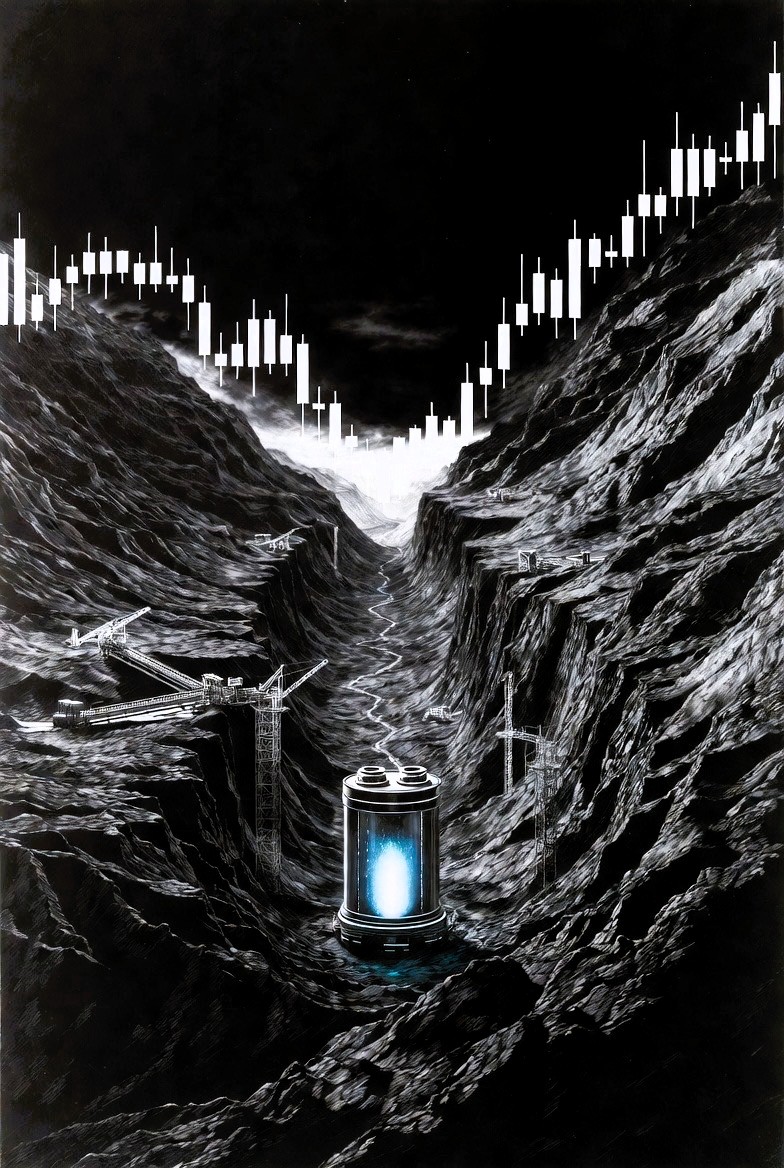
The selloff is occurring as much of the sector is already trading near 52-week lows. Many graphite companies are entering what resource investors commonly describe as the “valley of death,” a stage of the development cycle where promising projects face financing, permitting, and construction risks before reaching commercial production.
This phase—well known in mining through the framework developed by Pierre Lassonde—often produces the deepest pessimism in resource equities despite improving long-term fundamentals.
For long-term investors, periods when cyclical pessimism coincides with short-term policy shocks have historically produced some of the most compelling entry points in commodity markets.
Today’s combination of policy volatility and late-stage development pessimism has created precisely that environment within the graphite sector.
For investors willing to look beyond near-term noise, the current dislocation presents an exceptional asymmetric opportunity.
.
.
Macro Investment Thesis
.
.
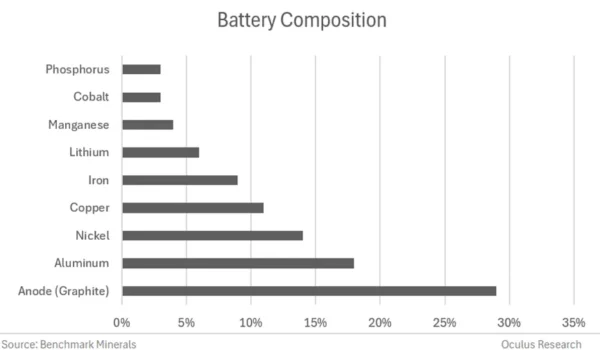
Graphite is the largest component of lithium-ion batteries, yet the global supply chain remains overwhelmingly controlled by China. As electrification accelerates and energy storage deployment expands, policymakers across North America and Europe continue to prioritize diversified and secure battery supply chains.
Graphite is one of the most essential materials in modern battery technology.
Every lithium-ion battery contains significantly more graphite by weight than lithium.
.
.
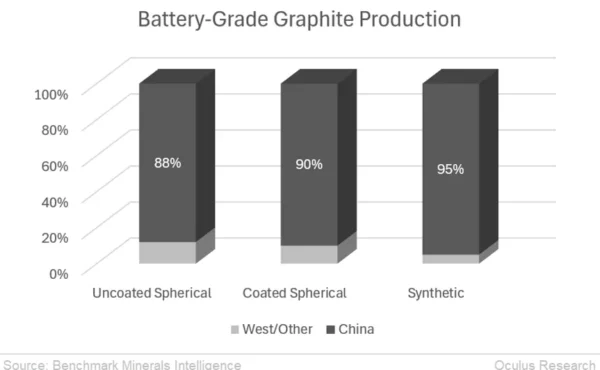
While graphite is geologically abundant, the industrial capacity required to transform graphite into battery-grade anode material remains highly concentrated in China.
China currently dominates:
• graphite mining
• spherical graphite processing
• anode material production
.
.
The result is a market defined not by geological scarcity, but by industrial concentration and processing constraints.
This concentration represents a strategic vulnerability for Western & ex-China economies attempting to build domestic battery supply chains.
The inflection point:
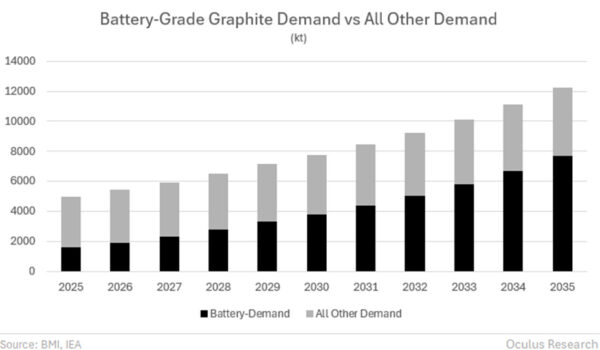
Graphite demand in battery applications is accelerating rapidly as electric vehicles and grid-scale energy storage systems expand globally.
.
.
Battery demand is projected to represent the majority of graphite consumption within the next decade, fundamentally reshaping the structure of the market.
From a structural perspective, the key drivers underpinning the graphite investment thesis remain intact:
• accelerating electric vehicle adoption
• exponential growth in grid-scale energy storage
• geopolitical pressure to localize battery supply chains
These dynamics create a structural opportunity for companies capable of developing ex-China graphite supply chains.
.
.
Where the Market is Wrong
.
.
The current market interpretation is anchored in the wrong time-frame.
Pricing is being driven by:
- near-term policy uncertainty
- weak or inconsistent near-term demand signals
- and a general risk-off approach to pre-production assets
In doing so, the market is:
- pricing short-term policy noise over long-term industrial strategy
- overlooking graphite’s future demand landscape
- applying aggressive discounts to assets that sit furthest from cash flow
This creates a structural disconnect.
.
.
The Challenge: Execution
.
.
Despite the strong macro-outlook, the graphite sector carries significant execution risk.
Mining and processing projects face numerous challenges:
• permitting and regulatory timelines
• construction and capital requirements
• qualification with battery manufacturers
• operational ramp-up risk
Many promising graphite projects are still in early development stages
Individual company outcomes can vary significantly.
For this reason, concentrating exposure in a single graphite company introduces unnecessary risk.
.
.
Strategic Approach: A Diversified Convexity Basket
.
.
The most effective expression to the broad dislocation is a diversified basket of graphite companies positioned across different jurisdictions, points on the curve, and stages of development.
This approach captures the structural upside of the graphite supply chain transition while reducing the impact of project-specific execution risk. Each company within the basket plays a distinct strategic role within the emerging ex-China graphite supply chain.
The rational behind a diversified basket extents beyond risk management.
The market is not mispricing a single company, it is mispricing the entire ex-China supply chain. Capital is constrained at multiple points along the curve. In addition to balancing risk, the basket’s construction effectively expresses the broader dislocation.
No single asset captures the full scope of the opportunity.
Exposure across the ex-China supply chain expresses the view that:
- the constraint is systemic
- the build out will be uneven
- value will emerge across multiple stages
Diversification is not simply defensive, it is structural to the thesis.
.
.
The Diversified Convexity Basket
.
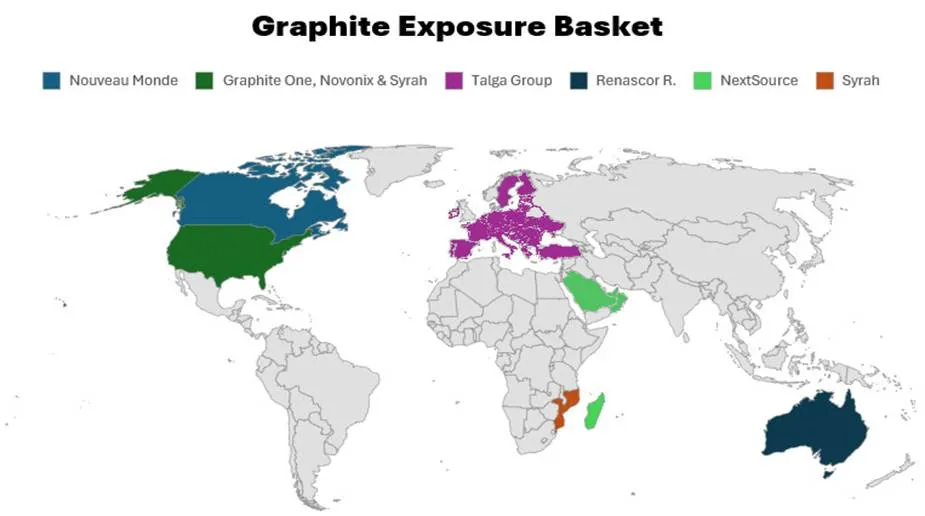
.
Allocations strategically cover regions with significant reserves & jurisdictional importance.
Company Strategic Role Allocation
Nouveau Monde: North American integrated supply chain 20%
Graphite One: U.S. domestic supply chain 15%
NextSource: Early production + processing Strategic GCC supply 15%
Talga Group: European graphite independence 15%
Novonix: 100% Synthetic producer 15%
Renascor Resources: High-convexity development project 10%
Syrah Resources: Existing global-scale producer 10%
.
.
Nouveau Monde Graphite:
Strategic Western Supply Anchor (20%)
.
.
1. Strategic Role
Nouveau Monde represents one of the most advanced integrated graphite development projects in North America.
The company is pursuing a vertically integrated model combining mining, purification, and anode material production in Quebec. This structure positions the company as a potential cornerstone supplier within the emerging North American battery ecosystem.
2. Investment Thesis
• Premier North American integrated project – strategic jurisdiction
• Tier-1 offtake agreements/partners – Panasonic & Gov deals
• Strong gov. backing/policy alignment – Fed referrals, potential grants/tax credits
• Low-cost producer – hydro-powered
• Vertical integration – economic moat
3. Core Assets
Matawinie Mine
· Located in Quebec
· Full construction scheduled 2026 – Commercial production 2028
· Approx. 106,000 tpa (tonnes per annum) (expected) – 25 year mine life
Bécancour Battery Material Plant
· Located in Quebec
· Facility to process raw graphite into active anode material
· Engineering and procurement underway – commercial production 2029
· Approx. 44,000 tpa coated spherical graphite (expected)
4. Strategic Importance
Nouveau Monde is the premier North American ESG-driven supplier of graphite. The company utilizes green, hydroelectric power to produce high-purity, carbon-neutral anode material. The company plays an essential role in reducing Western reliance on Chinese supply chains.
5. Catalysts
• Final Investment Decision – Phase-2 Matawinie Mine/Bencaour Plant – H2 2026
• Conversion of expressions of interest to debt/equity packages (prerequisite of FID)
• construction commencement – slated for Q1 2026
• Product qualification (testing with partners)
6. Key Risks
• Dilution risk – capital raises
• Technical risk- AAM purification yields still unproven at commercial volumes
• Timeline risk – construction – supply chain bottlenecks (caterpillar electric mining fleet)
7. Upside Scenario
If Nouveau Monde Graphite achieves its near-term de-risking milestones it will successfully transition from development-stage explorer to the primary North American supplier.
.
.
Graphite One:
Strategic U.S. Domestic Supply (15%)
.
.
1. Strategic Role
Graphite One is developing what could become a fully domestic U.S. graphite supply chain, including mining in Alaska and downstream processing facilities in Ohio.
2. Investment Thesis
· Largest U.S. graphite reserve
· Aligned with U.S. policy priorities: critical mineral security & defense supply chains.
· U.S. gov backed – DOD grants & 2 billion (non-binding) financial interest (EXIM)
· Exp. to capture the full value chain – processing, recycling, & synthetic production
3. Core Assets
Graphite Creek Mine
· Located in North Alaska (claims cover 23,680 acres)
· Completed bankable feasibility study (15 months ahead of schedule), in permitting stage
· Approx. 175,000 tpa (based on only 12% of deposit) – 20-year life mine
Advanced Graphite Materials Facility & Recycling Facility
· Located in Ohio
· Final stages of financing to support design, permitting, & equipment procurement
· Approx. 169,000 tpa coated spherical graphite, 25,000 tpa purified graphite products (expected)
4. Strategic Importance
Graphite One is in a critical demand jurisdiction with heighted geopolitical supply risk. If successful, it will be the first 100% U.S.-based graphite supply chain. The company is critical component of ensuring the U.S.’s National Defense and Energy Security.
5. Catalysts
• Formal EXIM bank application outcome – expected 2026
• Finalization of Engineering & Design – Ohio plant
• Alaska mine permitting (timetable)
• Phase 1 Synthetic Production – Mid 2027 (first commercial cashflows)
• Solidification of non-binding agreements (Lucid) – additional offtake agreements
• REE testing/technical updates – potential supplementary revenue stream
6. Key Risks
• Funding gap – High capex vs. market cap – must be covered by debt or equity (dilution)
• Delays in permitting – Alaska is a notoriously difficult permitting jurisdiction
• Dual site coordination – execution risk – trans-continental logistics
7. Upside Scenario
If execution stays on track, the company is positioned to be a high-margin, generational asset. The company is estimated to have an NPV of 5 billion, with an IRR of 27% (post tax). The discovery of magnet and heavy rare earth elements (2025) could significantly lower the effective net cost of the company’s graphite production.
.
.
NextSource Materials:
SuperFlake Producer & Strategic GCC Supply Chain (15%)
.
.
1. Strategic Role
NextSource owns one of the largest and highest-quality flake graphite mines in the world. The ore from their mine in Madagascar contains no harmful impurities rendering it is easily upgradable to 99.97% purity (Battery-grade). The company performs primary processing directly at the mine site producing and shipping high-purity graphite concentrate.
The company is expanding into producing coated, spheronized, and purified graphite for battery applications with a facility strategically located in Abu Dhabi – aiming to be one of the largest anode producers outside of Asia.
2. Investment Thesis
• Existing producer ramping up mining & processing of high-quality graphite concentrate
• Expanding into a vertically integrated producer of battery anode material
• Processing project in UAE supported by local sovereign-linked entities
• Planned large-scale facilities in Saudi Arabia
• Multi-year (binding) offtake agreement with Mitsubishi Chemical Corp.
3. Core Assets
Molo Graphite Mine
· Located in Madagascar
· Phase 1 operations – ramp up – current capacity 11,000 tpa of flake graphite concentrate
· Approx 150,000 tpa of SuperFlake graphite concentrate (expected) – 30-year mine life
UEA Battery Anode Facility
• Located in Abu Dhabi
• Advanced stage – site secured – first equipment arrived Jan 2026
• Approx 30,000 tpa battery-grade anode material (expected)
4. Strategic Importance
NextSource Materials is positioned to become a major strategic supplier of processed graphite within the GCC. The Company’s regional presence is a cornerstone of the UAE’s and Saudi Arabia’s ambitions to become critical mineral processing hubs.
5. Catalysts
• Final Investment Decision for EAU BAF – as soon as March 2026
• Finalization of Hanwa & JOGMEC investment in EAU BAF
• Qualification satisfaction – testing with Mitsubishi Chemical Corp. and major OEMs
• Progression of BAF in Saudi Arabia
6. Key Risks
• Funding requirements- BAF – $291 million – dilution risks – timeline delay
• Construction risks – UAE BAF – cost overruns & delays
• Qualifying – meeting Mitsubishis strict requirements
• Jurisdictional risk in Madagascar (mine) – political instability
7. Upside Scenario
NextSource Materials is positioned to be a cost-leader, leveraging UAE’s infrastructure and low-cost energy – giving it a significant margin advantage over Western-based competitors. If the company successfully expands into Saudi Arabia and executes its plan for a 100,000 tpa facility the company will transform from a niche player into a global heavyweight.
.
.
Talga Group:
Europe’s Strategic Graphite Independence (15%)
.
.
1. Strategic Role
Talga is developing a vertically integrated graphite anode supply chain in Sweden, positioning itself as a potential cornerstone of EU’s battery materials independence.
2. Investment Thesis
• Aligned with EU industrial policy & push to develop domestic battery supply chains.
• EU “Strategic Project” status – accelerated permitting – financing access – offtake
• Proprietary low-energy micronizing/purification technology – low carbon footprint
• Vertically integrated European producer – strategic supply chain independence
3. Core Assets – “Vittangi Anode Project”
Nunasvaara South Graphite Mine
· Located in Sweden
· Final stages of FID & Zoning – exploitation concession & environmental permits secured
· Approx. 100,000 tpa of high-grade ore expected– 24 year mine life (pot. Expansion)
(Mine designed to operate 6 months of the year – reduce impact on reindeer)
Luleå Anode Refinery
· Located in Sweden
· Commercial refining in permitting and pre-FID stage – demo plant operational
· Approx 24,500 of “Talnode-C” (coated active anode graphite material) expected
4. Strategic Importance
Talga is positioned to significantly reduce Europe’s dependence on imports for critical materials, enabling its prioritization of its green transition. Talga aims to be the “greenest producer in the world”, through the use hydropower and its proprietary purification technology.
5. Catalysts
• Finalization of “Industrial Leap 2 Grant” – early 2026 ($180 million grant – Swedish Gov.)
• Finalization of funding package – Q2 2026 (€150 million EIB loan/ €70 million EU grant)
• Finalization of FID
• Construction commencement of Lulea Anode Refinery – 2026
6. Key Risks
• Capital requirements (1 billion USD) – dilution risk
• Grant dependency – Failure to secure Industrial Leap 2 may prolong timelines
• Historical high cash burn
• Notoriously complex and exhaustive EU bureaucratic bottlenecks
• Project has been in “development” phase for 13+ years – significant timeline risks
7. Upside Scenario
If Talga successfully commissions its mine and anode facility, it will become a cornerstone supplier to Europe’s emerging battery ecosystem. Currently, Europe imports almost all anode material from China. Talga is positioned to become Europe’s first domestic anode producer. The company’s low-carbon footprint aligns it with EU regulations and appeals to ESG-conscious manufacturers enabling it become Europe’s key supplier and command a significant price premium for “green” Graphite.
.
.
Novonix:
America’s Synthetic Graphite Backbone (15%)
.
.
1. Strategic Role
Synthetic graphite currently represents the majority of battery anode material due to its superior purity, consistency and performance in high-energy lithium-ion batteries
2. Investment Thesis
• Leading synthetic graphite producer in North America
• DOE backing – $754 million conditional loan
• Tier-1 offtake agreements – Stellantis, PowerCo (Volkswagen), Panasonic Energy
• Proprietary Tech – low-carbon synthetic producer
3. Core Assets
Riverside Facility
• Located in Tennessee, USA
• Commissioning & Qualification phase
• Currently producing 3,000 tpa – 20,000 tpa (expected)
• New “Enterprise South” facility in the planning/pre-construction – 31,500 tpa (targeted)
Cathode Facility
• Located in Nova Scotia, Canada
• Divested in Feb 2026 – retains a 15% stake and continues to hold related IP
4. Strategic Importance
Novonix holds critical strategic importance for the Western market. It holds the predominant domestically controlled, high- purity supply chain for synthetic graphite. Currently, China controls 95% of synthetic production – a critical bottleneck in critical demand segments. Synthetic graphite is the preferred choice in high-performance and mission critical sectors: Hypersonic & Space Vehicles, Military Aviation, Stealth Technology, & Semiconductors.
5. Catalysts
• Commencement of mass production of synthetic graphite (Riverside Facility) – 2026
• Panasonic production timeline – delivery of mass-produced anode material- 2027
• Ability to reach targeted 20,000 tpa at Riverside facility
• Initiation of Enterprise South Facility
• DOE loan finalization ($754 million) into binding agreement – liquidity event
6. Key Risks
• Delays – failure to meet Panasonic energy requirements/delivery – already pushed back
• Dilution risk -high cash burn – short runway
• Qualification risks – satisfying offtake quality requirements
• Permitting risk- Enterprise South Facility – experiencing environmental push back
7. Upside Scenario
If Novonix successfully navigates the valley of death, it has the potential to become the dominant North American supplier of synthetic graphite – a critical material for Industrial and National security.
.
.
Renascor Resources:
High-Convexity Tier-1 Developer (10%)
.
1. Strategic Role
While earlier stage than several peers, the project offers significant long-term potential. Its geographic location positions it as a key vertically integrated supplier in the Western and Asia-Pacific battery supply chain.
2. Investment Thesis
• Tier-1 mining jurisdiction
• Largest proven reserve outside of Africa -40-year mine life
• Lowest quartile of the cost curve – durable profitability – Zero debt
• Utilizes a proprietary hydrofluoric acid (HF)-free processing technology – ESG
• Major Project Status – Australian Fed gov backed -conditional gov loan approval
3. Core Assets
Siviour Graphite Deposit
• Located in South Australia
• Final development & pre-construction phase – All regulatory approvals received
• Approx 150,000 tpa of graphite concentrate expected – 40-year mine life
BAM Processing Facility
Located in South Australia
Received provisional development authorization – Demonstration Plant Phase.
Approx. 100,000 tpa of purified spherical graphite (expected)
4. Strategic Importance
Renascor Resources is strategically positioned to be the low-cost, vertically leader in the ex-China supply chain. The company’s hydrofluoric acid-free purification method meets strict ESG standards and enables the company to potentially command a premium for its “green” anode material.
5. Catalysts
• Commissioning of purified spherical graphite demonstration plant – H1 2026
• Product qualification – delivery/validation of samples
• Conversion of non-binding agreements (Mitsubishi/POSCO) to binding agreements
• Secondary/Final approvals for construction commencement for BAM facility
• FID in construction of BAM facility
6. Key Risks
• Capital requirement – dilution risk
• Scale-up challenges- demonstration plant to commercial BAM facility
• Technological risk – failure to achieve required quality grades in commercial HF process
• Final approvals – regulatory/environmental for BAM facility
7. Upside Scenario
Renascor Resources has the potential to be the cost-leader in ex-China graphite supply. The company’s Siviour deposit is a generational Tier-1 asset capable of returning multi-decade returns. If the company successfully transitions from developer-to-producer, it stands to be significantly re-rated.
.
.
Syrah Resources:
Established & Vertically Integrated (10%)
.
1. Strategic Role
Syrah Resources is among the closest Western producers to fully integrated battery-grade graphite supply, offering exposure to the largest existing graphite producers outside China.
The company operates the Balama graphite mine in Mozambique, one of the largest graphite deposits globally. Downstream, its Louisiana facility is already in commercial ramp-up and product qualification phase.
2. Investment Thesis
• Currently the only vertically integrated ex-China supplier of active anode material
• Holds the world’s largest natural graphite reserve – 50+ year mine life
• Strategically positioned to benefit from U.S. domestic supply shocks – trade tensions
• Federal funding & Grants – U.S. Policy support
• High-Value offtake agreements: Tesla, Lucid, POSCO, NextSource
3. Core Assets
Balama Graphite Mine
• Located in Mozambique
• Operational – currently in campaign mode amidst price fluctuations & local disruptions
• 350,000 tpa of graphite concentrate (expected) – 50-year mine life
Vidalia Active Anode Material Facility
• Located in Louisiana (USA)
• Initial commercial production – currently in qualification and ramp-up phase
• Approx. 45,000 tpa active anode material (expected)
4. Strategic Importance
Syrah provides a critical alternative to Chinese dominance for global battery and automotive manufacturers. The company’s facility in Vidalia, Louisiana, is considered a critical asset in U.S. efforts to secure critical minerals for defense, electric vehicles, and specialized applications.
5. Catalysts
• Tesla Material Qualification – March 2026 deadline – Failure allows for termination
• Lucid Supply Commencement – early 2026
• FID for Vidalia facility expansion
• Monetization of (Section 48C) Tax credits – can be sold or used to offset liabilities
• Acquisition of clients/agreements with ex-China customers for Balama concentrates
6. Key Risks
• Significant debt – highly leveraged – Urgent funding needs
• Material Uncertainty cited by auditors – company ability to continue as a going concern
• Tesla Default & Termination – currently under default notice – quality requirements
• Political instability risk at Balama mine Mozambique – Force majeure 2024
7. Upside Scenario
Validation of quality specifications by Tesla would be a game changer for Syrah Resources. It would prove Vidalia can produce battery-grade anode material at scale, making Syrah the only commercial-scale vertically integrated supplier ex-China.
.
.
Who This is For
.
This framework is not designed for broad participation.
It is relevant for:
- long-duration capital willing to underwrite multi-year development timelines
- institutions positioning ahead of structural supply chain shifts
- investors comfortable with pre-cash flow and development-stage assets
The opportunity sits in a segment of the market that requires:
patience, tolerance for volatility, and a longer investment horizon.
It is not a constraint, it is the opportunity.
.
.
Conclusion: Capturing Structural Convexity
.
The graphite market is undergoing a structural transformation driven by electrification, energy storage growth, and geopolitical supply chain realignment.
This is not a timing trade.
It is positioning into a supply chain that does not yet exist but will have to.
The opportunity is not in predicting the narrative.
It is in owning the assets before the narrative arrives.
.
.
Position Sizing & Timing
.
The graphite sector remains early in its development cycle. Volatility should be expected.
Rather than attempting to time an exact bottom, positions should be built gradually through a disciplined allocation strategy.
Oculus’ preferred approach is a three-stage entry framework:
• Initiate a starter allocation (~1/3) at current valuations
• Add exposure on sector-wide weakness or project-specific volatility
• Deploy remaining capital during broader market dislocations
This approach allows investors to participate in the structural thesis while maintaining flexibility as the sector evolves.
.