

Lifezone is not a nickel investment, it is a conditional bet on whether high-grade, Western-aligned supply can survive in a market increasingly defined by manufactured abundance.
.
.
Overview
.
Lifezone Metals is primarily a Nickel mining and refining company in the development stage. It’s flagship nickel project, “Kabanga Nickel Project”, located in Tanzania, is one of the worlds largest and highest-grade undeveloped nickel sulfide deposits. The company’s proprietary edge lies in its Hydromet Technology, which serves as a cleaner, lower-cost alternative to traditional smelting. The company is also in the in the feasibility stage of developing its “U.S. PGM Recycling Project” that utilizes the Hydromet Technology to recycle PGMs from spent automotive converters in the Unites States.
.
.
I. The Setup
.
.
Lifezone was positioned as a cost leader in high-grade nickel production and a key supplier of battery anode quality nickel. Its hydrometallurgical technology (Kell Process) is a advantageous alternative to traditional smelting solving fundamental, long-standing problems in metal refining, particularly in efficiency, environmental impact, and cost-efficiency. Lifezone was built for a market defined by scarcity. That market, however, no longer exists in its original form.
.
.
II. The System Shift
.
.
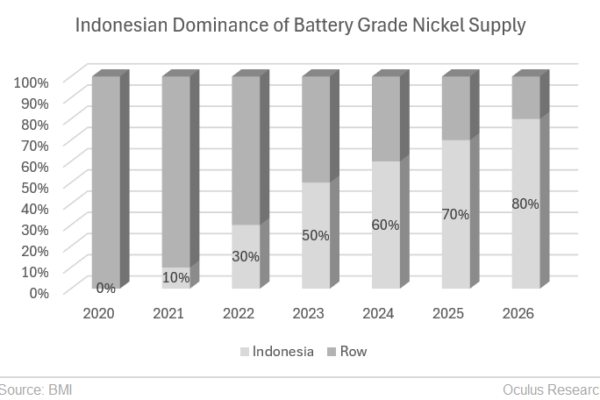
In 2020 Indonesia placed a ban on raw export restrictions, forcing foreign investment in processing capabilities. This led to a boom in refining capacity fueled by the development of HPAL facilities. High-Pressure Acid Leach (HPAL) plants enable low-cost processing of largely abundant Class 2 (low-grade) Nickel. The process produces Mixed Hydroxide Precipitate (MHP), a high-purity feedstock suitable for battery and high-nickel chemistries.
This shift transformed the Nickel market. High-purity nickel has transitioned from geological scarcity to abundance, defined by industrial manufacturing capacity. Indonesia, supported by extensive Chinese investment, became the vertically integrated cost leader for both low- and high-grade nickel.
.
.
The implication is critical: nickel is no longer constrained by geology. It is constrained by processing, geography, and policy.
.
.
Where the Market is Wrong
.
.
- Pricing Lifezone as a standard development-stage Nickel project
- Underestimating geopolitical fragmentation of supply chains
- Ignoring potential premium for Western-aligned, ESG-compliant production
.
.
III. The Conditions
.
.
Lifezone does not work unconditionally.
Its success is dependent on a narrow set of conditions holding simultaneously:
Pricing
- First-Quartile AISC: Feasibility indicates $3.36 lb.
- Diversification Protection: Copper/Cobalt credits & PGM recycling
- ESG/Domestic Premium: Crucial supply for Western offtake
Geopolitics
- Localized refining: eliminates concentrate transportation – reducing risk
- Tanzanian Alignment: Deepening cooperation between Tanzania and US
- Nickel Supply shock: ~75% of Indonesian high-purity feedstock is Chinese controlled and is included in and at risk of Chinese export restrictions.
Processing Advantage
- Cost parity with Indonesian HPAL must be achieved and sustained.
- Process: Hydromet is a cleaner, low temp/pressure and faster process
- ESG: substantially lower carbon footprint than HPAL (30-50%)
- High-purity: precision impurity separation – meeting strict specifications
.
.
IV. The Split Outcome
.
.
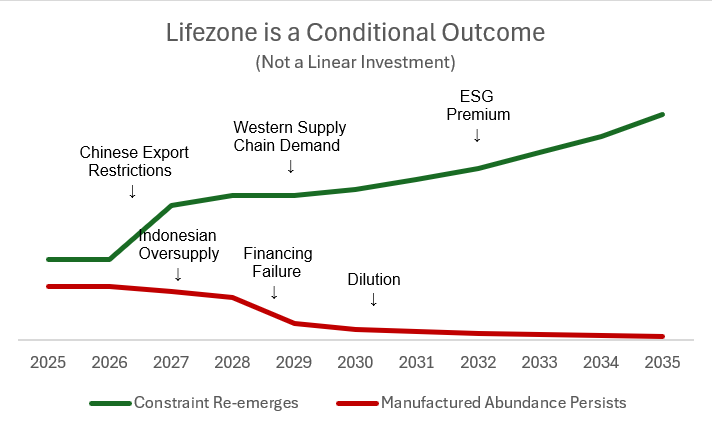
This is not a linear outcome. The investment resolves in two very different directions depending on whether the above conditions hold.
.
.
If The System Shifts Back Toward Constraint
.
.
Demand
- Exponential growth in anode battery and component demand
- ESG mandates/preference create significant premium for low-carbon Nickel
- Continued shift towards domestic ex-China supply chains
Supply Contraction
- Low nickel prices continue to reduce exploration, leading to available ore depletion
- Further reduction of Nickel production quotas by Indonesian government
- Supply is significantly disrupted via Chinese export restrictions that directly impact 75% of Indonesian producers/supply
- Geopolitical tensions escalate creating a significant supply shock
Alternative Revenue
- Copper (134kt) and Cobalt (69kt) projected credits increase earnings
- PGM recycling facility is successful (projected at 220,000 oz of 3E PGMs annually)
- Lifezone licenses its proprietary Hydromet tech creating additional revenue.
.
.
If Abundance persists & Execution Fails
.
.
Financial
- Inability to secure strategic partnerships:
- Negotiations fail to secure financing- failure could halt development
- Sustained cash burn without financing halts project development
Operational
- Company fails to commercially scale its Hydromet Technology
- Failure to meet quality and ESG standards in commercial production
- Logistical friction in Kabanga’s remote region of Tanzania that lacks infrastructure
- Failure to successfully develop/operate complex underground Kabanga mine.
Geopolitical
- Tanzania sovereign risk – 16% owner of the project
- Permitting and final approval delays
Nickel price suppression and Substitution
- Nickel prices in the shorter-term impact projects economic viability
- Continued low-cost supply from Indonesia puts a ceiling on the Nickel price
- A significant shift towards Lithium Iron Phosphate batteries (that do not use nickel) reduces overall Nickel demand.
.
.
Ⅴ. Conclusion
.
.
Lifezone is not a traditional commodity investment.
It is a conditional expression of a much larger shift within the nickel market.
The company was built for a world defined by scarcity, one in which high-grade sulfide deposits commanded structural value. That world has been disrupted. Supply is no longer dictated solely by geology, but by processing capacity, capital, and policy.
The outcome, therefore, is not linear.
If manufactured abundance continues to dominate, and Indonesian supply remains unconstrained, Lifezone risks being structurally outcompeted before it reaches full scale.
If, however, the system shifts, through geopolitical fragmentation, policy intervention, or supply disruption, the value of high-grade, Western-aligned, low-carbon production re-emerges rapidly.
In that scenario, assets like Kabanga are no longer marginal, they become essential.
The market, for now, appears to be pricing the former.
The opportunity exists only if the latter begins to take shape.
.